
Nuclear Magnetic Resonance
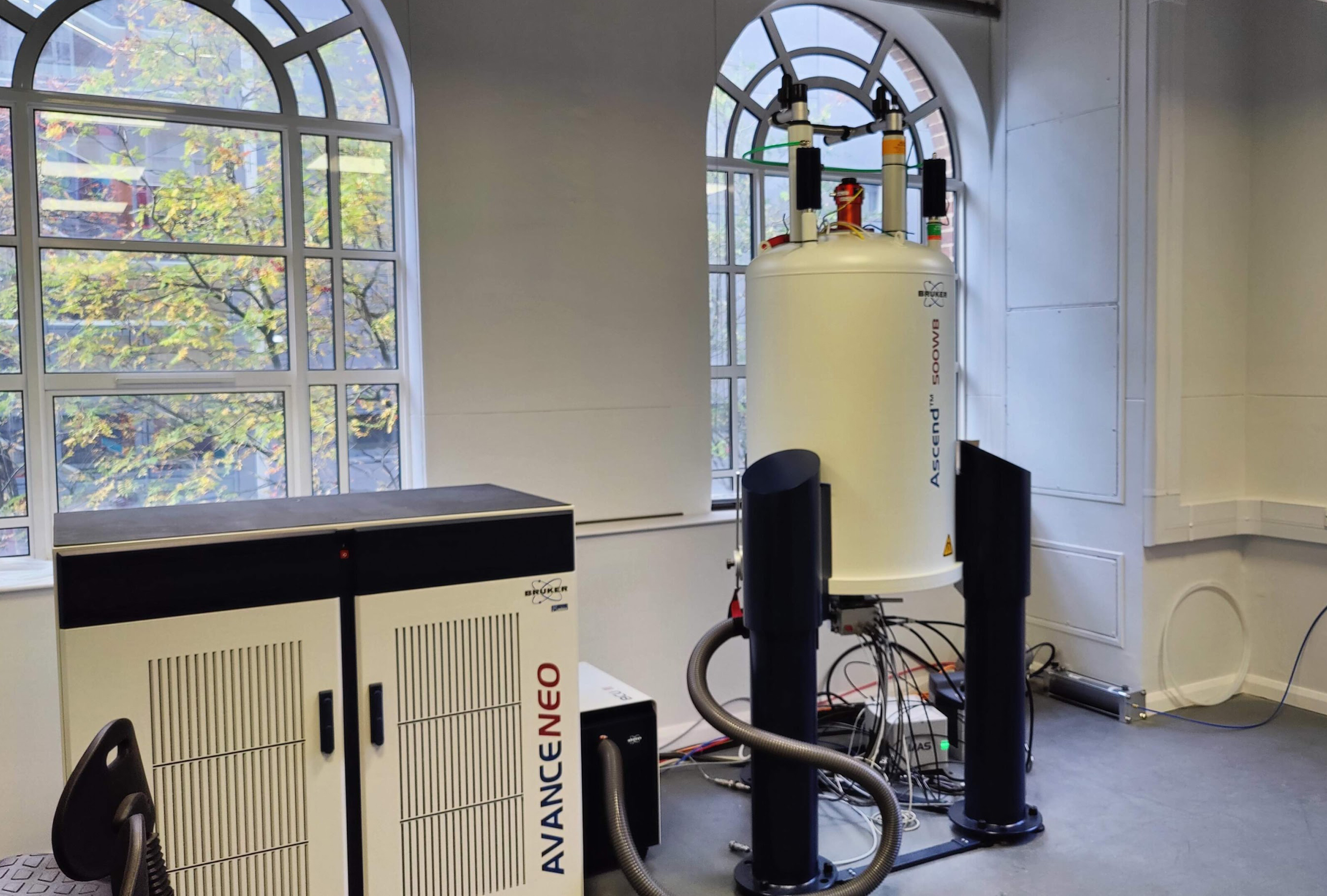
The Nuclear Magnetic Resonance (NMR) Facility provides comprehensive capabilities for solution-state and solid-state NMR spectroscopy, enabling detailed structural, dynamic, and quantitative characterisation of small molecules, materials, polymers, pharmaceuticals, catalysts, and functional solids.
The facility supports both routine and advanced NMR experiments for academic and industrial users, covering molecular structure elucidation, solid-state phase analysis, crystallinity, polymorphism, molecular dynamics, and intermolecular interactions.
Specifications
The facility houses a suite of high-field solution and solid-state NMR spectrometers, equipped with modern probe technologies and variable-temperature control to support a wide range of nuclei and experimental modalities.
- 2x Bruker 400 MHz spectrometers for routine analysis, equipped with SampleXpressTM autosamplers.
- Bruker Avance 600 MHz for high resolution analysis, equipped with SampleCase PlusTM autosampler.
- Bruker Avance Neo 500 MHz WB solid state NMR spectrometer, equipped with three probes.
- Triple resonance X/Y/F-H 4mm CP-MAS DVT probe (max. spin rate 15kHz)
- Triple resonance X/Y/H 1.3mm CP-MAS DVT probe (max. spin rate 15kHz)
- 1H optimized 4mm double resonance HR-MAS probe (max. spin rate 65kHz)
Solution-state NMR capabilities
High-resolution solution NMR for routine and advanced molecular characterisation.
Specifications
- High-field superconducting magnets (400 and 600 MHz)
- Broadband multinuclear capability (1H, 13C, 19F, 31P, 15N and others)
- Cryoprobe and/or broadband probes [as applicable]
- Automated sample changers for high-throughput analysis
- Variable-temperature control (typically −80 °C to +150 °C)
- Advanced digital spectrometers with modern pulse programming
Typical Experiments
- 1D 1H and 13C NMR
- Quantitative NMR (qNMR)
- 2D correlation experiments (COSY, TOCSY, HSQC, HMBC, NOESY/ROESY)
- Diffusion-ordered spectroscopy (DOSY)
- Kinetics, stability, and reaction monitoring
- Impurity profiling and structural confirmation
Solid-state NMR capabilities
Advanced solid-state NMR for the structural and dynamic analysis of crystalline, amorphous, and heterogeneous materials.
Specifications
- High-field solid-state NMR spectrometer
- Magic-angle spinning (MAS) capability across multiple rotor sizes
- Variable-temperature MAS operation
- Multinuclear solid-state probes for spin ½ (1H, 13C, 19F, 31P, 15N and others) and quadrupolar nuclei (2H, 11B, 23Na, 27Al and others)
- Cross-polarisation and direct-excitation experiments
Typical Experiments
- 13C and 15N CP/MAS
- Direct-excitation MAS or static NMR
- Variable-temperature and dynamics studies
- Polymorphism and phase identification
- Amorphous vs crystalline content
- Structure–property relationships in functional materials
Advanced Experiments
- 2D Proton detected fast MAS experiments
- 2D Heteronuclear Correlation (HETCOR) experiments
- 2D Homonuclear Correlation 13C experiments (DARR, PDSD, RFDR)
- 2D multiple-quantum magic-angle spinning (MQMAS) experiments to get high-resolution spectra of quadrupolar nuclei that are challenging to study with conventional methods
- Non-Uniform Sampling (NUS) acquisition for multi-dimensional experiments to reduce acquisition time

You can discuss the feasibility of your experiment and be supported throughout the allocated time and analysis.
Contact us