
Top
Skip to Content
LOGO(small) - Queen's University Belfast
  • Our facebook
  • Our x-twitter
  • Our youtube
  • Our instagram
LOGO(large) - Queen's University Belfast

School of

Law

  • Home
  • Study
    • Undergraduate
    • Postgraduate Taught
    • Postgraduate Research
    • Graduate Degrees
    • Why Law at Queen's
    • Student Experience
    • Student Blog
    • Pathways to Qualification
  • Research
    • Research Projects
    • Research Environment
    • Impact and Engagement
    • Law Lab
    • Publications
    • Research Students
    • Northern Ireland Legal Quarterly
    • Visiting Scholars
    • Visiting Students
    • Public Lectures
    • Postdoctoral Research
  • Employability
    • Employer Engagement
    • Legal Practitioners
    • Recent Graduates
    • Legal Placement Module (UG)
    • Extracurricular Skills
    • Mooting
    • Alumni Testimonials
  • About
    • Location
    • Facilities
    • Diversity and Inclusion
    • Student Law Society
    • Pathways Opportunity Programme
    • Fordham Summer School
  • People
    • Academic Staff
    • Administrative Support
  • News
    • Archive 2021-22
    • Archive 2019-20
    • Archive 2018-19
    • Archive 2017-18
    • Archive 2016-17
    • Archive 2015-16
  • Events
    • Events 2023-24
    • Events 2024-25
    • Events 2025-2026
  • Home
  • Study
    • Undergraduate
    • Postgraduate Taught
    • Postgraduate Research
    • Graduate Degrees
    • Why Law at Queen's
    • Student Experience
    • Student Blog
    • Pathways to Qualification
  • Research
    • Research Projects
    • Research Environment
    • Impact and Engagement
    • Law Lab
    • Publications
    • Research Students
    • Northern Ireland Legal Quarterly
    • Visiting Scholars
    • Visiting Students
    • Public Lectures
    • Postdoctoral Research
  • Employability
    • Employer Engagement
    • Legal Practitioners
    • Recent Graduates
    • Legal Placement Module (UG)
    • Extracurricular Skills
    • Mooting
    • Alumni Testimonials
  • About
    • Location
    • Facilities
    • Diversity and Inclusion
    • Student Law Society
    • Pathways Opportunity Programme
    • Fordham Summer School
  • People
    • Academic Staff
    • Administrative Support
  • News
    • Archive 2021-22
    • Archive 2019-20
    • Archive 2018-19
    • Archive 2017-18
    • Archive 2016-17
    • Archive 2015-16
  • Events
    • Events 2023-24
    • Events 2024-25
    • Events 2025-2026
  • Our facebook
  • Our x-twitter
  • Our youtube
  • Our instagram
In This Section
  • Events 2023-24
  • Events 2024-25
  • Events 2025-2026

  • Home
  • School of Law
  • Events
  • Events 2025-2026

Events 2025-2026

Re-imagining (Re)production in Intellectual Property Law:

Back to events

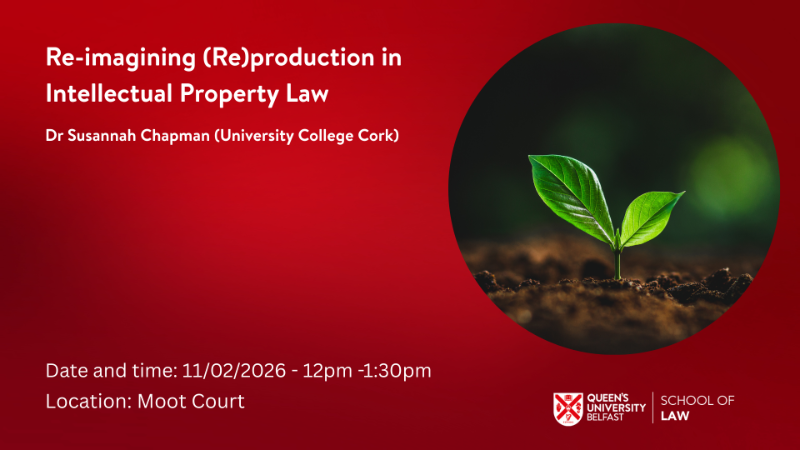
Re-imagining (Re)production in Intellectual Property Law: New frontiers in the branding and making of botanical kinds
Date(s)
February 11, 2026
Location
Moot Court - MST 02.006
Time
12:00 - 13:30

Over the past several decades, many fruit breeding programs have started to commercialize new varieties via the strategic use of three legal techniques: the use of plant variety protection to restrict varietal reproduction, the use of contracts to create small “clubs” of select growers, and the use of varietal branding to foster ready consumer demand for the protected fruit that the club would produce. In these highly proprietary supply chains, the production of new varieties is inextricably tied to the seasonal production of brand-compliant fruit. This talk explores the work that is required to make an already-existing variety grow into to its varietal image year after year. In doing so, it invites reflection on the distinction between creative production and mundane reproduction that permeate many accounts of plant breeding by exploring the work of “making” that comes after the “creation” of new botanical kinds. Implied in the internal infrastructure through which intellectual property law identifies its object is the idea that crop varieties are produced (bred or “created”), after which they are classified and named. Once bred and authored into the world, the variety is effectively reproduced (cultivated), unless and until it is “bred” into something different. Such a distinction maps onto wider genealogical models of reproduction-as-generation. Cultivation here is generally not envisaged as a creative act, but a reproductive—or copying—one. Rather, it is only in certain instances of plant reproduction, where there is a biological or genetic shift in the progeny that is deemed sufficient to create a break in botanical kind, that the copying reproduction of cultivation is reclassified as a creative, productive act of breeding. In following the creative work of growing brand-compliant crop varieties, this talk shows how emerging intellectual property arrangements are reworking, in some ways, the very distinctions between reproduction and production upon which they depend. Such re-imagining opens up space to consider, however narrowly, the ways in which plant reproduction—and reproduction more broadly—is always enmeshed in wider social, ecological, and technoscientific relations.

Event type
Lecture / Talk / Discussion
Department
Audience
All
Add to calendar
Share
  • Facebook
  • Twitter
  • LinkedIn
  • Weibo
  • Email
Events
  • Events
  • Events 2023-24
  • Events 2024-25
  • Events 2025-2026
QUB Logo
Contact Us

Contact


School Of Law

Main Site Tower
University Square
Belfast BT7 1NN

All Enquiries
  • +44(0)28 90975122
  • law-enquiries@qub.ac.uk

GET DIRECTIONS

Mailing List


Keep up to date with the latest news and events from the School by joining our Mailing List

Quick Links


  • Study
  • Research
  • People
  • About
  • News

Social Media


© Queen's University Belfast 2024
  • Privacy and cookies
  • Website accessibility
  • Freedom of information
  • Modern slavery statement
  • Equality, Diversity and Inclusion
  • University Policies and Procedures
Information
  • Privacy and cookies
  • Website accessibility
  • Freedom of information
  • Modern slavery statement
  • Equality, Diversity and Inclusion
  • University Policies and Procedures

© Queen's University Belfast 2024

Manage cookies