Top
Skip to Content
LOGO(small) - Queen's University Belfast
  • Our facebook
  • Our instagram
  • Our x-twitter
LOGO(large) - Queen's University Belfast

The Seamus Heaney Centre

  • Home
  • About
    • The Centre
    • The Blackbird
    • The Heaney Community
    • Collections at the Seamus Heaney Centre
  • Our People
    • The SHC Fellows
    • Ciaran Carson & Publishing Fellows
    • Children's Writing Fellow
    • Visiting International Poetry Fellows
  • Study
    • The Poetry Summer School
    • Regular Projects
    • Weekly Writing Groups
    • Hear from Alumni
    • Trust Your Voice
  • Resources
    • SHC Publications
    • Criticism & Ideas on Writing
    • The SHC Podcast
    • Tiny Masterclasses
  • First Collection Poetry Prize
    • Poetry Prize 2026
    • Poetry Prize 2025
    • Poetry Prize 2024
    • Poetry Prize 2023
    • Poetry Prize 2022
  • Events
    • SHC Presents...
    • Conferences
    • Reading Seamus Heaney
    • Translation
  • News
  • Home
  • About
    • The Centre
    • The Blackbird
    • The Heaney Community
    • Collections at the Seamus Heaney Centre
  • Our People
    • The SHC Fellows
    • Ciaran Carson & Publishing Fellows
    • Children's Writing Fellow
    • Visiting International Poetry Fellows
  • Study
    • The Poetry Summer School
    • Regular Projects
    • Weekly Writing Groups
    • Hear from Alumni
    • Trust Your Voice
  • Resources
    • SHC Publications
    • Criticism & Ideas on Writing
    • The SHC Podcast
    • Tiny Masterclasses
  • First Collection Poetry Prize
    • Poetry Prize 2026
    • Poetry Prize 2025
    • Poetry Prize 2024
    • Poetry Prize 2023
    • Poetry Prize 2022
  • Events
    • SHC Presents...
    • Conferences
    • Reading Seamus Heaney
    • Translation
  • News
  • Our facebook
  • Our instagram
  • Our x-twitter
In This Section
  • The Friday Critique
  • Notions
  • The Saturday Matinee
  • The Sunday Spotlight
  • Twelve Picks of Christmas
  • Call and Respond

  • Home
  • Seamus Heaney Centre
  • Resources
  • Criticism & Ideas on Writing
  • Call and Respond

Call and Respond

Criticism isn't always in the form of a traditional review, instead we call for writers to simply 'respond', this can be in anyway they seem fit. A poem, a reflection, even an analysis or comparison.  We are called to respond. 

Call and Respond is a project created to generate more ekphrasis practice. Writers view an collection, exhibition or art work, and respond in a creative, critical or reflective mode. 
 

We are looking for....

Reviews of art pieces and exhibition that may not easily attract press attention. 

With an emphasis on new artists/ solo exhibits. 

Thoughtful and original writing, with considered arguments and clear ideas.

Brevity! (2200 characters!) 

Call and Respond is a free form, experimental ekphrasis process, open to the idea of discussion and conversation. 

Send submissions or enquiries to Darcey at - shc@qub.ac.uk

Read down below or
Follow our social media

The first project we have the pleasure of responding to is artist Lin Li's 'Across Eurasia, Encountering Ulster', a solo exhibition that ran from the 4th of December 2025 - 8th January 2026, in Room 2, Belfast. 

Born in China and based in Ulster, Lin combines East Asian philosophical perspectives with Ulster landscapes to create a unique painterly language. Her exhibition  invites audiences to experience a dialogue between continents, cultures, and personal memory, positioning Lin as a rising voice in contemporary art.
Vortex of Bóthar n bhFál Dorcha (Lin Li)
'Across Eurasia, Encountering Ulster'
Nicole Lee Jiaqi Responds

I step inside the gallery and close the door behind me. Ah. I think. I’ve stepped into the mind of Lin Li– into the artist’s inner world, an extension of herself.

A gallery of thoughts swimming around me. Colour. Texture. Motion held in stillness. The exhibition is titled ‘Across Eurasia, Encountering Ulster’. The paintings feel unmistakably cross-cultural: landscapes of Ulster filtered through another way of seeing. I finally read the leaflet in my hand. Lin Li draws on East Asian painterly philosophies such as qiyun shengdong and cunfa, spirit resonance paired with textural brushwork, to depict European terrain through the lens of an Asian artist.

As a Malaysian-Chinese person who has lived in Belfast for over a year, I recognise this feeling immediately. To live abroad is to feel universally different and universally familiar at the same time. I went home and kept thinking: What is it that feels so distant, yet so close? Contradictions can coexist, of course. But what I was sensing here felt more precise than contradiction. It was nuanced. Specifically, culturally nuanced. Ways of seeing that overlap without collapsing into one another. This is where intersectionality lives for me: not through conflict, but layering.

In Lin Li’s work, through the lens of intersectionality, spirit resonance does not belong solely to the land or to the artist. It emerges from their encounter. My favourite painting was ‘Sleepwalking Dún Lúiche’. Viewed through the lens of intersectionality, ‘Sleepwalking Dún Lúiche’ becomes more than a gorgeous, green landscape with three pieces of quiet architecture still in the distance; the painting as a whole is a site of extended identity and negotiated belonging formed through cultural transition. Thus, the overlapping, dreamy texture becomes a record of the negotiation within an artist who has moved from China to Northern Ireland, rather than sole mastery of traditional technique.

Lin Li’s approach to painting Dún Lúiche depicts what her mind has translated the landscape into from an East-Asian lens. She has also resisted a singular narrative of the perception of Irish landscape, instead offering a creative, dreamlike difference shaped by cultural roots, migration, and an artist’s presence.

I’d like to believe I understand Lin Li’s work relatively thoroughly. I think people like us try to bring the memory of home wherever we go. We try to hold onto our identity as we try to belong.

Read more Read less

Vortex of Bóthar n bhFál Dorcha
Colette Henry Responds

A tapestry of soft textured leaves covers a fragile forest floor.

An archway of vibrant flames and colours forms an artificial sky overhead.

This is a complex impasto in which imagination and reality collide.

Two forces appear in opposition, two worlds battling for control?

I am guided gently along a pathway, but I make no sound.

A shimmering silhouette in the distance?

I do not question and follow obediently.

I am locked into this mystical journey now.


These fálta dorcha are filled with wonder.

The sense of disorientation becomes overwhelming.

Emotions fluctuate between intrigue and fear, appreciation and curiosity.

I willingly disconnect from reality as I cross over from landscape to dreamscape.


But this is no allegorical journey.

No Dante’s selva oscurra.

No mid-life crisis nel mezzo del cammin di nostra vita.

This is a fragile passageway between reality and fantasy.


I surrender to the hypnotic power and acquiesce to this mystical trance.

This is nature’s kaleidoscopic vortex.

Yes, I know where I’m going now.

This is a gateway to my infinite imagination where everything is possible.

Read more Read less

Ten Minutes After Sunset, Béal Feirste
Darcey Youngman Responds

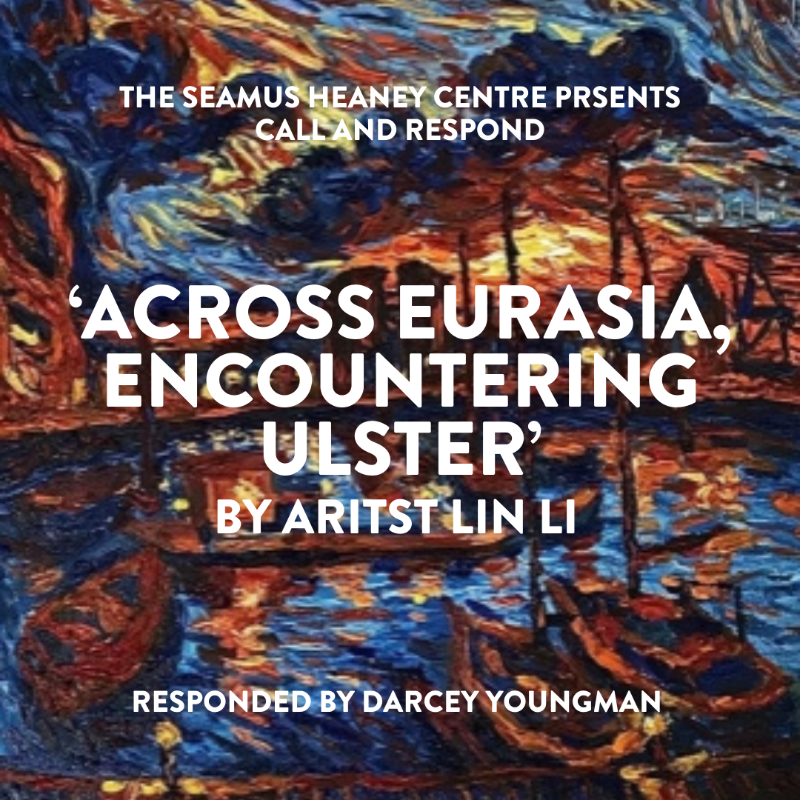
Lin Li’s ‘  Across Eurasia, Encountering Ulster’, combines East Asian techniques to an Irish anthem, bringing together two cultures who appreciate that true meanings lie within nature and landscape.

When I saw the painting by Lin Li in Room 2, Belfast, I thought of the poems of this land. The rhymes of Seamus Heaney, words of Claire Keegan and Kevin Barry, using the land to represent the deeper traumas. I felt the senses and sensibilities of Louis MacNeice, a physical reaction. Each of these writers write like a painter, crafting each word, each line to an image. Lin Li tells this story using the Irish landscape and culture as her muse. 

It’s not uncommon for the artist to be inspired by the landscape, especially here in Ireland. It is woven into the culture. We are constantly responding to what we see, what we feel and what we hear, we are constantly in conversation with the land. 

However, Lin Li brings something playful, punchy and vibrant. She brings in colours, and a 3D element to the paintings. One such painting was Ten Minute After Sunset, Beal Feirste. Using oil paints, the oranges and yellow clash into the shimmering blues as she depicts the infamous Belfast Docs. Both violent and calming, the picture brings a disruption to the stillness, the calm of an Irish Landscape. It brings a new life, a new perspective. The elements of Belfast’s nature, its Industrial air co-existing almost with its ancestry of green, vast landscape. Lin Li highlights with her source of colours, that two things can be true at the same time. 

Another highlight was ‘Golden Portaigh’ , a scene so familiar brought to life through heavy yet deliberately placed brush strokes to present grass and reeds. It looked tactile and physical, as if she was mimicking the motion of a farmer and laborer. It took on its own life. It also resembled that of an East Asian landscape, a farmer working, shining hills behind, a universal visual for both cultures Lin Li is representing. 


It reminded me of a Heaney poem, funnily enough, 

‘And if I spy into the i golden loops

I see us walk between the railway slopes. 

Into an evening of long grass and midges.’   


Lin Li’s exhibition represented an Irish landscape through its colour, texture and use of oil paint. It shows an all familiar scene brought to life with a loving perspective. It urged me to research more into East Asian artists and culture to see how indeed they can be in conversation with the culture here. 


Read more Read less

The Silence Ghaibhóile
Fionntán Macdonald

How does an artist capture a feeling? It’s not as simple as the application of a particular pigment or technique, otherwise anyone with time and resources could be a master painter, but neither is it some inscrutable phenomena. An artist can’t recreate the feeling of a setting sun sizzling through the trees or dusk descending like silence over a cottage. They can only hope to communicate, somehow, these intangible moments. So the question persists, how?

Lin Li makes these intangibles beautifully, viscerally tangible and I think they do so in a deceptively simple way. By showing us how they did it.

I love to get close to a painting: obnoxiously close. I want to be able to get a better sense of what actually went into a painting, how each articulation of brush or palette knife has shaped the portrait. After all, art is about process just as much as product. Lin Li’s process is daubed and scraped into every millimetre of her canvas. You can observe how they have shaped the paint to the folds and creases of the landscape, just as they experienced it. You can see how the material has dried and calcified over time and settled into a final frame of experience. Paintings aren’t two dimensional things, after all. They’re crafted objects, layered and stratiform and dynamic.

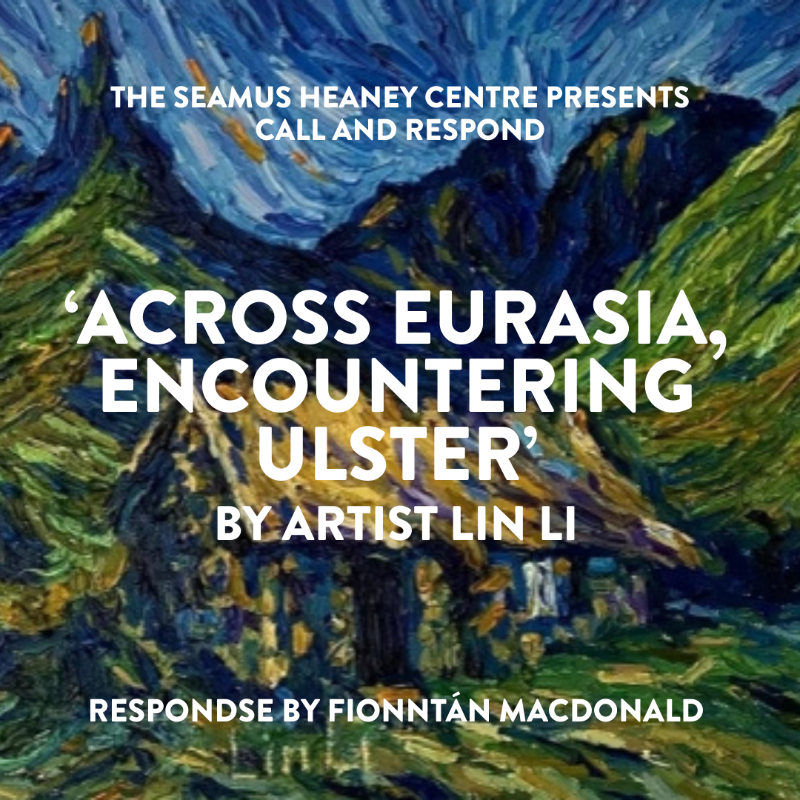
I don’t know the feeling of The Silence Ghaibhóile but when I got up close to Li’s depiction of the scene I couldn’t help thinking that she must have captured it. From an inch away you can see their hand at work and appreciate the action taken to communicate the abstract emotion that each element of the scene sparked in them. Their brush did not move over the sky in strokes but swoops, drying into frozen waves of azure and cobalt. The paring knife can’t have slid over the hills but rolled, sculpting palpable crags and crevices. The thatching doesn’t lie dead on the cottage roof but sort of blazes up from the homestead even as its door, concave in all its blackness, sinks into the domicile in such a way that it almost pulls you in. It gives less of an impression of someone encountering Ulster, but an artist embedding themselves in it, soaking up the feeling of the landscape and answering through meticulous, arduous but incredibly vital process how, exactly, to capture the feeling of it.

Lin Li’s Encountering Ulster series was certainly a personal project, and one best experienced up close.

Read more Read less

Criticism & Ideas on Writing
  • Criticism & Ideas on Writing
  • The Friday Critique
  • Notions
  • The Saturday Matinee
  • The Sunday Spotlight
  • Twelve Picks of Christmas
  • Call and Respond
QUB Logo
Contact Us

Seamus Heaney Centre
38-40 University Road, Belfast
BT7 1NN

GET DIRECTIONS

Phone: 028 9097 1077
Email: shc@qub.ac.uk 

Quick Links

  • Home
  • Study
  • People
  • Literary Belfast
  • News
  • Events

© Queen's University Belfast 2024
  • Privacy and cookies
  • Website accessibility
  • Freedom of information
  • Modern slavery statement
  • Equality, Diversity and Inclusion
  • University Policies and Procedures
Information
  • Privacy and cookies
  • Website accessibility
  • Freedom of information
  • Modern slavery statement
  • Equality, Diversity and Inclusion
  • University Policies and Procedures

© Queen's University Belfast 2024

Manage cookies